
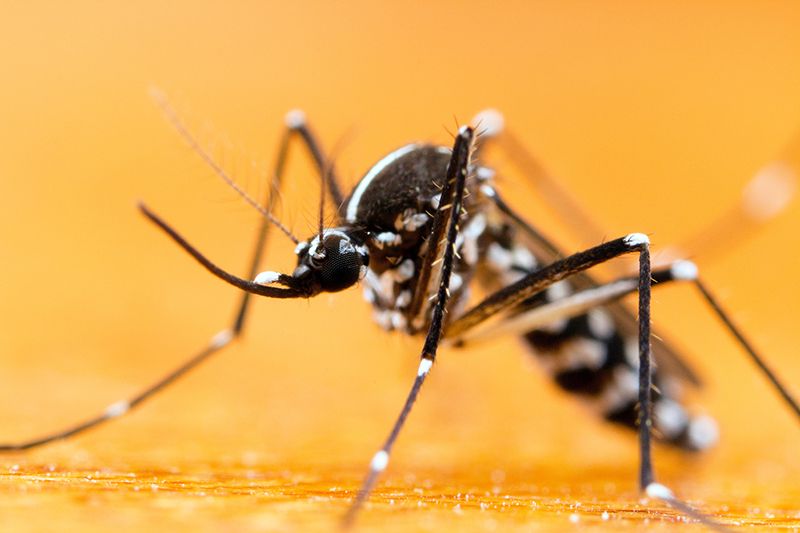
Vectors are generally organisms which spread infection from one to another organism without being affected. Some insects like Drosophila melanogaster and mosquitoes (especially Culex spp.) are the primary sources to transfer vector-borne diseases especially arboviruses including flavivirus genus which consist of West-Nile virus, Dengue virus and Zika virus which cause deadly diseases in human leading to high morbidity rate, such as around 390 million cases per year due to DENV (Bhatt et al. 2013); while vaccines are unavailable for most of these viruses.
To control viral risk, insects explicitly use antiviral signalling pathway. To approach most RNA viruses, Drosophila melanogaster utilise JAK/STAT pathway (Kemp et al. 2013). Recently published study by Ahlers et al. (2019) have explored insulin like receptors in fruit flies and mosquitoes, that when triggered, disrupt the duplication of West Nile Virus and suppress titre of Dengue and Zika virus. This research might have extremely high prospective for identification of different innovations to control the vector-borne diseases.
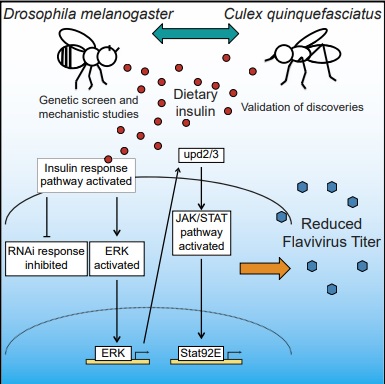
As the components of JAK/STAT pathway proved to be necessary in increasing virus mortality, any mutation in genes of this pathway showed less viral mortality rates as compared to control group having no mutations. The mutant group was more susceptible to WNV infection because of changes in insulin signaling pathway. Therefore, Ahlers et al. (2019) were able to confirm increase in mosquito’s immunity against WNV infection.
Over the years, scientists tried to discover the antiviral treatment for those viruses, but it is still unknown. Ahlers et al. (2019) was the first one who discovered the insulin’s connection with an immune response pathway. It is an important step towards the sustainable opportunity of creating an innovation in antiviral therapy. To sum up, I believe that if the virus load could be reduced by activating mosquito’s immunity through insulin receptor then humans would not get infected, as they are bit by the mosquitoes.
References
Ahlers, L., Trammell, C., Carrell, G., Mackinnon, S., Torrevillas, B., Chow, C., Luckhart, S. and Goodman, A. (2019) “Insulin Potentiates JAK/STAT Signaling To Broadly Inhibit Flavivirus Replication In Insect Vectors”. Cell Reports 29 (7), 1946-1960.e5
Bhatt, S., Gething, P., Brady, O., Messina, J., Farlow, A., Moyes, C., Drake, J., Brownstein, J., Hoen, A., Sankoh, O., Myers, M., George, D., Jaenisch, T., Wint, G., Simmons, C., Scott, T., Farrar, J. and Hay, S. (2013) “The Global Distribution And Burden Of Dengue”. Nature 496 (7446), 504-507
Kemp, C., Mueller, S., Goto, A., Barbier, V., Paro, S., Bonnay, F., Dostert, C., Troxler, L., Hetru, C., Meignin, C., Pfeffer, S., Hoffmann, J. and Imler, J. (2013) “Broad RNA Interference–Mediated Antiviral Immunity And Virus-Specific Inducible Responses In Drosophila”. The Journal Of Immunology 190 (2), 650-658
