Since the existence of life on this planet, organisms have aged and then finally perished with time. Throughout all human history, there have been folklores about trying to reach immortality. However, in the recent years, with the fast leap of science, it seems like this tale of immortality (or at least increasing one’s age significantly), might just turn out to be a reality someday. Various scientists have been trying to understand the process of aging and trying to uncover methods that could delay ageing.
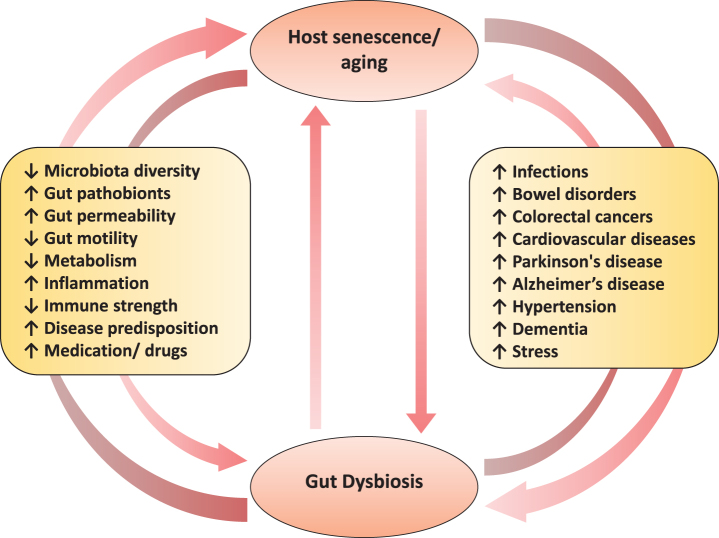
Kundu et al. (2019), have extensively experimented on mice of different ages. They have used the commonly present gut microbes from an old mouse and injected it into the gut of a younger mouse. This showed a significant increase in the young mouse’s neurogenesis capability along with other factors such as intestinal growth. It is known that gut microbes develop and mutate throughout the lifetime of a person (Nagpal et al. 2017). The combined study of these two groups provide significant evidence that gut microbes could be used to induce improved age-related characteristics in an organism.
In another study, Fahy et al. (2019), have conducted the first ever human trials to try and reverse aging. In the study termed as TRIIM (Thymus Regeneration, Immunorestoration, and Insulin Mitigation) trial, they have used a combination of growth hormone and two different diabetes medication, over a period of two years (2015- 2017); to try and reverse the epigenetic clock in humans. The term epigenetic clock refers to a process by which age can be determined by the level of methylation in DNA (Fransquet et al. 2019).
As teams of scientists and researchers around the world try to understand the process of aging; and to extend human life, through various studies and clinical trial; the main question to think about is whether humans are ready to have such power in their hands and will the process of delaying ageing have a negative effect on our society?
References
Fahy, G., Brooke, R., Watson, J., Good, Z., Vasanawala, S., Maecker, H., Leipold, M., Lin, D., Kobor, M. and Horvath, S. (2019). Reversal of epigenetic aging and immunosenescent trends in humans. Aging Cell, 18(6).
Fransquet, P., Wrigglesworth, J., Woods, R., Ernst, M. and Ryan, J. (2019). The epigenetic clock as a predictor of disease and mortality risk: a systematic review and meta-analysis. Clinical Epigenetics, 11(1).
Kundu, P., Lee, H., Garcia-Perez, I., Tay, E., Kim, H., Faylon, L., Martin, K., Purbojati, R., Drautz-Moses, D., Ghosh, S., Nicholson, J., Schuster, S., Holmes, E. and Pettersson, S. (2019). Neurogenesis and prolongevity signaling in young germ-free mice transplanted with the gut microbiota of old mice. Science Translational Medicine, 11(518), p.eaau4760.
Nagpal, R., Mainali, R., Ahmadi, S., Wang, S., Singh, R., Kavanagh, K., Kitzman, D., Kushugulova, A., Marotta, F. and Yadav, H. (2018). Gut microbiome and aging: Physiological and mechanistic insights. Nutrition and Healthy Aging, 4(4), pp.267-285.