Reversing Aging – Is Immortality on the Verge?

Since the existence of life on this planet, organisms have aged and then finally perished with time.  Throughout all human history, there have been folklores about trying to reach immortality. However, in the recent years, with the fast leap of science, it seems like this tale of immortality (or at least increasing one’s age significantly), might just turn out to be a reality someday. Various scientists have been trying to understand the process of aging and trying to uncover methods that could delay ageing.

Kundu et al. (2019), have extensively experimented on mice of different ages. They have used the commonly present gut microbes from an old mouse and injected it into the gut of a younger mouse. This showed a significant increase in the young mouse’s neurogenesis capability along with other factors such as intestinal growth. It is known that gut microbes develop and mutate throughout the lifetime of a person (Nagpal et al. 2017). The combined study of these two groups provide significant evidence that gut microbes could be used to induce improved age-related characteristics in an organism.
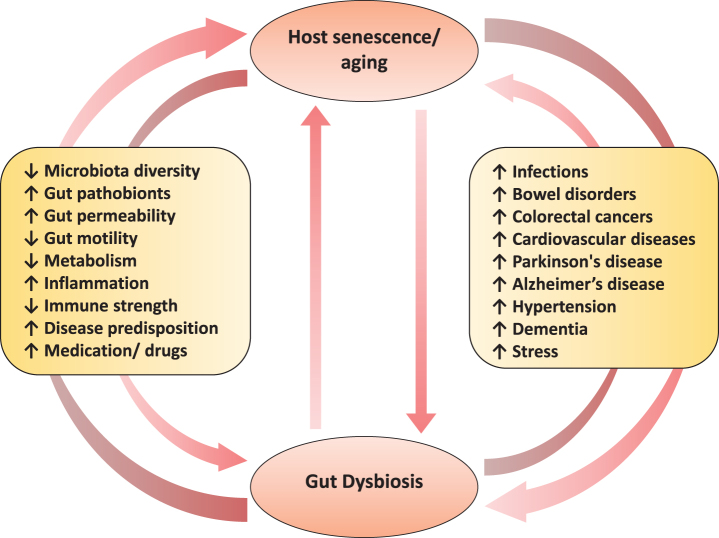
Fig: Relationship between gut microbes and aging (Nagpal et al. 2017).

In another study, Fahy et al. (2019), have conducted the first ever human trials to try and reverse aging. In the study termed as TRIIM (Thymus Regeneration, Immunorestoration, and Insulin Mitigation) trial, they have used a combination of growth hormone and two different diabetes medication, over a period of two years (2015- 2017); to try and reverse the epigenetic clock in humans. The term epigenetic clock refers to a process by which age can be determined by the level of methylation in DNA (Fransquet et al. 2019).

As teams of scientists and researchers around the world try to understand the process of aging; and to extend human life, through various studies and clinical trial; the main question to think about is whether humans are ready to have such power in their hands and will the process of delaying ageing have a negative effect on our society?

References

Fahy, G., Brooke, R., Watson, J., Good, Z., Vasanawala, S., Maecker, H., Leipold, M., Lin, D., Kobor, M. and Horvath, S. (2019). Reversal of epigenetic aging and immunosenescent trends in humans. Aging Cell, 18(6).

Fransquet, P., Wrigglesworth, J., Woods, R., Ernst, M. and Ryan, J. (2019). The epigenetic clock as a predictor of disease and mortality risk: a systematic review and meta-analysis. Clinical Epigenetics, 11(1).

Kundu, P., Lee, H., Garcia-Perez, I., Tay, E., Kim, H., Faylon, L., Martin, K., Purbojati, R., Drautz-Moses, D., Ghosh, S., Nicholson, J., Schuster, S., Holmes, E. and Pettersson, S. (2019). Neurogenesis and prolongevity signaling in young germ-free mice transplanted with the gut microbiota of old mice. Science Translational Medicine, 11(518), p.eaau4760.

Nagpal, R., Mainali, R., Ahmadi, S., Wang, S., Singh, R., Kavanagh, K., Kitzman, D., Kushugulova, A., Marotta, F. and Yadav, H. (2018). Gut microbiome and aging: Physiological and mechanistic insights. Nutrition and Healthy Aging, 4(4), pp.267-285.
A novel way to use spices for treating cancer

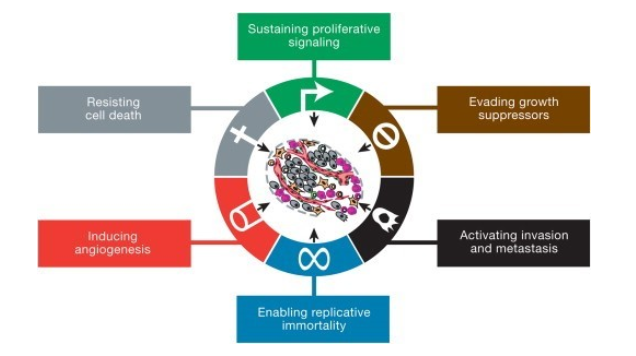
Cancer is known to be a highly fatal disease that leads to the formation of tumors; that is the abnormal growth of cells due to genetic mutations leading to resistance of cell death, uncontrolled proliferation and prevention of cell differentiation (Hanahan et al. 2011). Hence, these genetic products seem to be good targets for cancer therapy. Various scientists are now using these products for formation of target drugs. For example, STI-571 is effectively used for chronic myelogenous leukemia but there is a chance of relapsing (Mahon et al. 2010). 

Pillar of cancer (Hanahan et al. 2011) 

It is also known that turmeric could be used as a treatment for different diseases. Previously, a molecule called curcumin was discovered, which showed anti-cancer properties by interacting with ROS-metabolite enzymes (Larasati et al. 2018), increasing the ROS in the cells and arrest cell cycle; there by down regulating the formation of tumors.  

One of the best approaches to suppress the tumor is the control of ROS inside cells (Gorrini et al. 2013). But for this, a high dose of curcumin is required. Also, it is less absorbable in gut and less soluble in water (Nelson et al. 2017), so the analogous of curcumin were required to improve scarcity. 

Recently, Lestari et al. (2019) have successfully discovered an analogue of curcumin called pentagamavunon-1 (PGV1). Although, the PGV-1 acts on the same ROS as curcumin, it shows much better effects, such as irreversible tumor suppression with low doses. It specifically acts during prometaphase by arresting cell cycle in M-phase.  

PGV-1 reacts with ROS- metabolic enzymes by competing with their co-factors; thus, stressing the cells with ROS accumulation and leading to cell death by inhibiting the enzyme activity with more efficiency and low dose. Interestingly, PGV-1 mainly acts on cancerous cells with a minimal side effect on normal cells; and even after removal from the body; the anti-cancerous effects remain the same; which is unlike any drug ever seen. So, in accordance to Lestari et al. (2019) results, I believe that PGV-1 has a high chance of being developed into an orally consumable anti-cancer drug. 

References

Gorrini, C., Harris, I. and Mak, T. (2013). Modulation of oxidative stress as an anticancer strategy. Nature Reviews Drug Discovery, 12(12), pp.931-947.

Hanahan, D. and Weinberg, R. (2011). Hallmarks of Cancer: The Next Generation. Cell, 144(5), pp.646-674.

Larasati, Y., Yoneda-Kato, N., Nakamae, I., Yokoyama, T., Meiyanto, E. and Kato, J. (2018). Curcumin targets multiple enzymes involved in the ROS metabolic pathway to suppress tumor cell growth. Scientific Reports, 8(1).

Mahon, F., Réa, D., Guilhot, J., Guilhot, F., Huguet, F., Nicolini, F., Legros, L., Charbonnier, A., Guerci, A., Varet, B., Etienne, G., Reiffers, J. and Rousselot, P. (2010). Discontinuation of imatinib in patients with chronic myeloid leukaemia who have maintained complete molecular remission for at least 2 years: the prospective, multicentre Stop Imatinib (STIM) trial. The Lancet Oncology, 11(11), pp.1029-1035.

Nelson, K., Dahlin, J., Bisson, J., Graham, J., Pauli, G. and Walters, M. (2017). The Essential Medicinal Chemistry of Curcumin. Journal of Medicinal Chemistry, 60(5), pp.1620-1637.

Let’s kill some flaviviruses viruses with Mosquito’s Immunity

Vectors are generally organisms which spread infection from one to another organism without being affected. Some insects like Drosophila melanogaster and mosquitoes (especially Culex spp.) are the primary sources to transfer vector-borne diseases especially arboviruses including flavivirus genus which consist of West-Nile virus, Dengue virus and Zika virus which cause deadly diseases in human leading to high morbidity rate, such as around 390 million cases per year due to DENV (Bhatt et al. 2013); while vaccines are unavailable for most of these viruses.

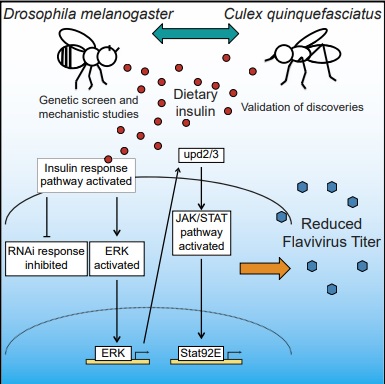
To control viral risk, insects explicitly use antiviral signalling pathway. To approach most RNA viruses, Drosophila melanogaster utilise JAK/STAT pathway (Kemp et al. 2013). Recently published study by Ahlers et al. (2019) have explored insulin like receptors in fruit flies and mosquitoes, that when triggered, disrupt the duplication of West Nile Virus and suppress titre of Dengue and Zika virus. This research might have extremely high prospective for identification of different innovations to control the vector-borne diseases.

Graphical presentation for the control of flaviviruses by dietary insulin in vectors (Ahlers et al. 2019)

As the components of JAK/STAT pathway proved to be necessary in increasing virus mortality, any mutation in genes of this pathway showed less viral mortality rates as compared to control group having no mutations. The mutant group was more susceptible to WNV infection because of changes in insulin signaling pathway. Therefore, Ahlers et al. (2019) were able to confirm increase in mosquito’s immunity against WNV infection.

Over the years, scientists tried to discover the antiviral treatment for those viruses, but it is still unknown. Ahlers et al. (2019) was the first one who discovered the insulin’s connection with an immune response pathway. It is an important step towards the sustainable opportunity of creating an innovation in antiviral therapy. To sum up, I believe that if the virus load could be reduced by activating mosquito’s immunity through insulin receptor then humans would not get infected, as they are bit by the mosquitoes.

References

Ahlers, L., Trammell, C., Carrell, G., Mackinnon, S., Torrevillas, B., Chow, C., Luckhart, S. and Goodman, A. (2019) “Insulin Potentiates JAK/STAT Signaling To Broadly Inhibit Flavivirus Replication In Insect Vectors”. Cell Reports 29 (7), 1946-1960.e5

Bhatt, S., Gething, P., Brady, O., Messina, J., Farlow, A., Moyes, C., Drake, J., Brownstein, J., Hoen, A., Sankoh, O., Myers, M., George, D., Jaenisch, T., Wint, G., Simmons, C., Scott, T., Farrar, J. and Hay, S. (2013) “The Global Distribution And Burden Of Dengue”. Nature 496 (7446), 504-507

Kemp, C., Mueller, S., Goto, A., Barbier, V., Paro, S., Bonnay, F., Dostert, C., Troxler, L., Hetru, C., Meignin, C., Pfeffer, S., Hoffmann, J. and Imler, J. (2013) “Broad RNA Interference–Mediated Antiviral Immunity And Virus-Specific Inducible Responses In Drosophila”. The Journal Of Immunology 190 (2), 650-658

css.php