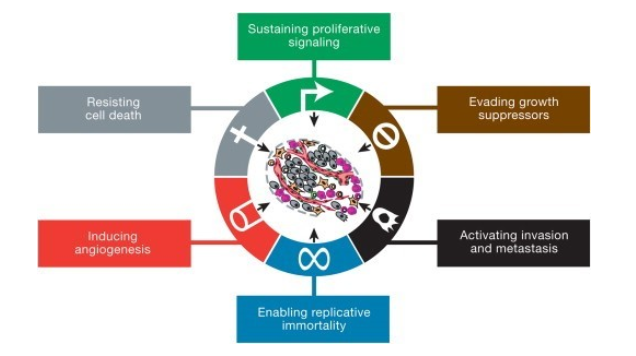
Cancer is known to be a highly fatal disease that leads to the formation of tumors; that is the abnormal growth of cells due to genetic mutations leading to resistance of cell death, uncontrolled proliferation and prevention of cell differentiation (Hanahan et al. 2011). Hence, these genetic products seem to be good targets for cancer therapy. Various scientists are now using these products for formation of target drugs. For example, STI-571 is effectively used for chronic myelogenous leukemia but there is a chance of relapsing (Mahon et al. 2010).
It is also known that turmeric could be used as a treatment for different diseases. Previously, a molecule called curcumin was discovered, which showed anti-cancer properties by interacting with ROS-metabolite enzymes (Larasati et al. 2018), increasing the ROS in the cells and arrest cell cycle; there by down regulating the formation of tumors.
One of the best approaches to suppress the tumor is the control of ROS inside cells (Gorrini et al. 2013). But for this, a high dose of curcumin is required. Also, it is less absorbable in gut and less soluble in water (Nelson et al. 2017), so the analogous of curcumin were required to improve scarcity.
Recently, Lestari et al. (2019) have successfully discovered an analogue of curcumin called pentagamavunon-1 (PGV1). Although, the PGV-1 acts on the same ROS as curcumin, it shows much better effects, such as irreversible tumor suppression with low doses. It specifically acts during prometaphase by arresting cell cycle in M-phase.
PGV-1 reacts with ROS- metabolic enzymes by competing with their co-factors; thus, stressing the cells with ROS accumulation and leading to cell death by inhibiting the enzyme activity with more efficiency and low dose. Interestingly, PGV-1 mainly acts on cancerous cells with a minimal side effect on normal cells; and even after removal from the body; the anti-cancerous effects remain the same; which is unlike any drug ever seen. So, in accordance to Lestari et al. (2019) results, I believe that PGV-1 has a high chance of being developed into an orally consumable anti-cancer drug.
References
Gorrini, C., Harris, I. and Mak, T. (2013). Modulation of oxidative stress as an anticancer strategy. Nature Reviews Drug Discovery, 12(12), pp.931-947.
Hanahan, D. and Weinberg, R. (2011). Hallmarks of Cancer: The Next Generation. Cell, 144(5), pp.646-674.
Larasati, Y., Yoneda-Kato, N., Nakamae, I., Yokoyama, T., Meiyanto, E. and Kato, J. (2018). Curcumin targets multiple enzymes involved in the ROS metabolic pathway to suppress tumor cell growth. Scientific Reports, 8(1).
Mahon, F., Réa, D., Guilhot, J., Guilhot, F., Huguet, F., Nicolini, F., Legros, L., Charbonnier, A., Guerci, A., Varet, B., Etienne, G., Reiffers, J. and Rousselot, P. (2010). Discontinuation of imatinib in patients with chronic myeloid leukaemia who have maintained complete molecular remission for at least 2 years: the prospective, multicentre Stop Imatinib (STIM) trial. The Lancet Oncology, 11(11), pp.1029-1035.
Nelson, K., Dahlin, J., Bisson, J., Graham, J., Pauli, G. and Walters, M. (2017). The Essential Medicinal Chemistry of Curcumin. Journal of Medicinal Chemistry, 60(5), pp.1620-1637.
